182 Days of Wisdom for Educators
The 182 Days of Wisdom for Educators project is designed to cut through the noise of modern education and provide a daily anchor for what actually matters. It is intended to be a quiet space to intentionally reflect on the craft of teaching, to reclaim our time and space, and to be the architects of learning environments where both students and educators can genuinely thrive. It is a form of micro-PD, easily digestible nuggets of reflection and action that you can put into practice quickly and easily.
Released every day, a simple, clean, clear message is delivered to your inbox and offers you the opportunity to take a moment to pause and reflect on the craft, the art of teaching. Student agency, curiosity and inquiry are consistent threads from each day to the next... so if you are an educator who truly values those aspects of education, you should subscribe to 182 Days of Wisdom for Educators straight away!
Here is Day 1 to get you started.


The C.O.D.E. Framework
The C.O.D.E. Framework is a pragmatic, modern, and accessible rival to traditional, rigid Concept-Based Curriculum approaches , developed specifically for educators who want to make friends with their mandated standards rather than fight them. Grounded in the core philosophy of being Curriculum-Informed First, Concept-Activated Second, it provides a mnemonic-driven methodology for modern, inquiry-driven, evidence-based planning. In practice, the framework guides teachers to use written standards and outcomes as the foundational bedrock, activate those outcomes by extracting disciplinary and anchor concepts to give the curriculum a heartbeat, transition into inquiry-driven pedagogy, and ultimately evaluate learning with data to genuinely measure conceptual transfer and growth.
C - Curriculum-Informed: Everything starts with the mandated standards or learning outcomes in your context (e.g. ACARA v.9, Common Core, etc.). The written curriculum is the foundational bedrock, ensuring teachers design learning that is grounded by the curriculum.
O - Organising Concepts: The "activation" phase. Extracting disciplinary and anchor concepts from the wording of the standards/outcomes to give the curriculum a heartbeat. Translating dry outcomes into relational truths that can be explored.
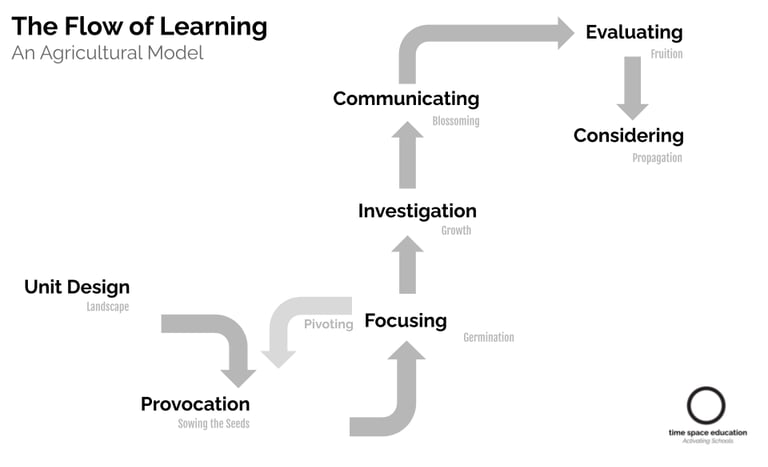
D - Driven by Inquiry: Moving from design to pedagogical planning. Mapping our Flow of Learning model, designing provocative experiences. integrating evidence-based teaching through intentionally-designed and structured scaffolds.
E - Evaluated by Evidence: Closing the loop. Anchoring the conceptual framework through thoughtfully-designed formative rubrics for understanding that guide learning, growth and conceptual transfer.
The Flow of Learning
The 'Flow of Learning' visual illustrates the structured, four-phase cognitive journey that powers the C.O.D.E. Framework. Moving seamlessly from design to pedagogical planning, it maps how students transition from initial curiosity to deep understanding. The cycle begins with a Provoke phase to hook the learner, driving them to Investigate and wrestle with curriculum-informed evidence. Students are then guided to Synthesize their findings, translating dry outcomes into relational truths and conceptual connections. Finally, the arc culminates in Transfer—the ultimate application where students prove their understanding in new contexts, allowing educators to genuinely measure conceptual growth and close the learning loop.